Cybersecurity protects computer systems, networks, and data from digital threats. As more businesses move their work online, the need for people with security skills continues to grow. A professional certification can help you learn the basics and show employers that you understand key security concepts. However, choosing the right course and exam matters. Some credentials focus on basic security principles, while others test networking, cloud security, and incident response. This guide compares five cybersecurity certifications for beginners in 2026. It explains their exam structure, key topics, difficulty, and career value so you can make an informed choice.
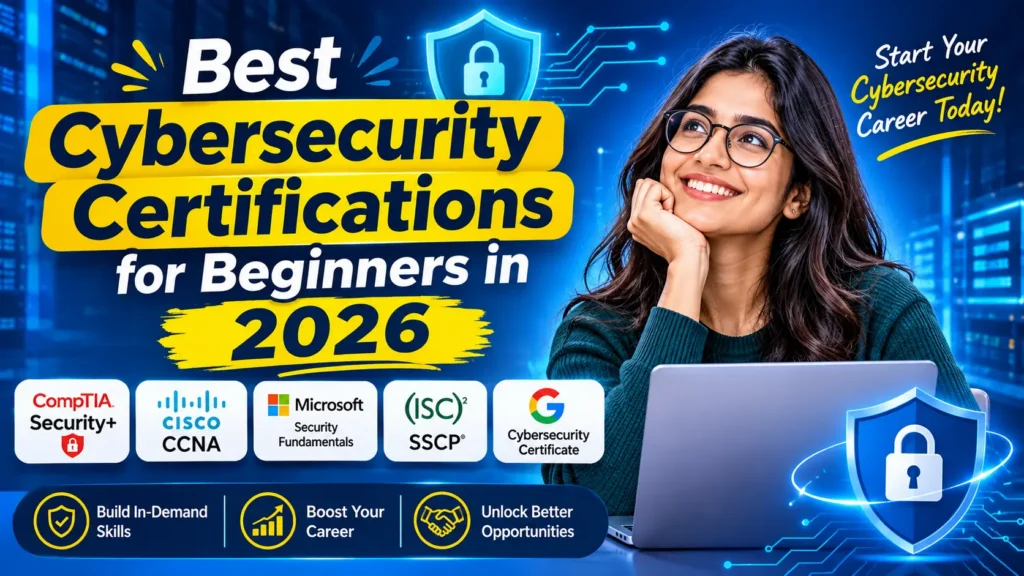
Best Cybersecurity Certifications for Beginners in 2026
Top 5 Cybersecurity Certifications for Beginners in 2026
Not every security credential has the same entry requirements or technical depth. Some suit people with no IT background, while others expect you to understand networks and operating systems. Here are five options worth considering based on their syllabus, exam format, and intended audience.
Detailed Explanations

No Subscription Required

Exam simulations

Mobile App Included

100% MoneyBack Guarantee
If you are not satisfied, we refund 100% of the purchase price.


501
Questions

0
Total Topics

Study Modes
- Practice Mode
- Exam Mode
- Flashcards


The Most Trending Certification Exams
- GH-600 exam prep: Microsoft Developing in Agentic AI Systems
- AB-731 exam prep: Microsoft AI Transformation Leader
- AI-103 exam prep: Microsoft Developing AI Apps and Agents on Azure
Show More... (7)
- AZ-140 exam prep: Configuring and Operating Windows Virtual Desktop on Microsoft Azure
- 70-247 exam prep: Configuring and Deploying a Private Cloud with System Center 2012
- 70-473 exam prep: Designing and Implementing Cloud Data Platform Solutions
- 70-532 exam prep: Developing Microsoft Azure Solutions
- 70-533 exam prep: Implementing Microsoft Azure Infrastructure Solutions
- 70-534 exam prep: Architecting Microsoft Azure Solutions
- 70-535 exam prep: Architecting Microsoft Azure Solutions - 70-534 INCLUDED FREE (231 questions more)
Prepare smarter
Why choose Certification Exam for AZ-104?
Practice with realistic certification exams, clear explanations and flexible study modes designed to help you improve faster.
- Updated questions and exam-style simulations
- Instant feedback with detailed explanations
- Study online or from the mobile app
1. ISC2 CC – Certified in Cybersecurity
The CC program by ISC2 is suitable for individuals who wish to enter the realm of security without prior experience in cybersecurity. The CC program deals with the basics of security practices and principles used in protecting information and handling risk. The outline of the exam for September 2026 consists of five domains, among which security operations and access management are prioritised.
The following are the key characteristics of the exam:
- Level: Entry-level.
- Duration of the exam: Two hours.
- Number of questions: 100–125 items.
- Passing score: 700 out of 1,000.
- Type of exam: Computer-adaptive testing.
- Key topics: Security principles, governance, identity and access management, network security, and incident response.
You will gain fundamental knowledge of security practices within the organisation. The topics of confidentiality, integrity, availability, authentication, and risk management are essential to your future as a security professional or IT support specialist.
ISC2 CC can be a wise decision in case of changing careers or starting anew. However, one should bear in mind that the free exam program is not available for new candidates anymore. Some existing candidates can still use previously issued exam vouchers before their expiry dates. Check the current registration terms before making a payment.
2. Security+ – Wide Ranging Technical Security Knowledge
Security+ is a globally recognized certification for individuals wishing to develop technical security knowledge. It covers techniques for threat identification, protection and incident response. In contrast to a fundamentals exam, it requires knowledge of how security controls can be applied in practice.
The latest exam information is:
- Exam code: SY0-701.
- Exam time: 90 minutes.
- Number of questions: up to 90.
- Types of questions: multiple choice and performance-based.
- Main areas: Threats, vulnerabilities, security architecture, security operations, and risk management.
Performance-based questions test the application of your knowledge. This could involve identifying a security risk, analyzing a scenario, and choosing a suitable control. Some basic understanding of TCP/IP, operating systems, firewalls and access controls will aid your preparation.
SY0-701 continues as the current English exam as of November 2026. Its successor, SY0-801, should launch around November 17, 2026, with SY0-701 retiring on June 11, 2027. Please check the exam version when purchasing any preparation material. Security+ is a suitable choice after developing your foundation in IT.
3. CCST Cybersecurity – Entry-Level Security Skills
This certification emphasizes the required skills for junior-level support jobs within IT and security areas. Network security, endpoint protection, vulnerability assessments, risk management, and incident handling fall under its scope. There are no formal prerequisites for the exam, thus making it possible for beginners to take the test.
Please keep the following in mind when enrolling in this course:
- Exam code: 100-160.
- Time allotted for the exam: 50 minutes.
- Exam cost: US$125; regional rates apply.
- Level: Entry-level.
- Subject areas: Security concepts, network security, endpoint security, and incident handling.
The syllabus offers the basic tasks that junior security professionals could be expected to perform. Some of these include identifying vulnerabilities and the importance of endpoint protection. These skills can be used as a basis for more advanced studies.
The beginner-level cybersecurity certification might be useful for students and career switchers who seek specialization in cybersecurity. Junior Cybersecurity Analyst learning path is self-paced and requires around 120 hours of study time. It could also serve as a solid foundation before obtaining an associate-level security certification.
4. GFACT – Foundational Cybersecurity Technologies
Technical expertise of computer systems and cybersecurity is what GFACT concentrates on. It includes hardware knowledge, virtualisation, network operations, operating systems, clouds and programming, exploitation, mitigation, and digital forensics.
According to the structure of the exam which has been released by GFACT:
- Exam time: Two hours.
- Number of questions: 75.
- Exam type: Proctored examination.
- Passing score: 71%.
- Exam fee: $399 per examination, not including any taxes.
The syllabus is highly technical. Technical knowledge of computers, networks, and operating systems will be required to understand the material better. The understanding of how they function might assist in comprehending why there are such vulnerabilities and how they are solved.
GFACT would be good for learners who like studying something technical and computing-related. But the exam fee is more expensive than some other entry-level certifications.
5. SC-900 – Security, Compliance, and Identity Fundamentals
SC-900 is a beginner-level certification for understanding the basics of cloud identity, security, and compliance. This exam explains the importance of identity management, security controls, and data protection. The SC-900 exam is recommended if you are interested in a career in cloud computing or identity security.
The following topics are covered:
- Level: Beginner.
- Duration of exam: 45 minutes.
- Topics: Security fundamentals, identity management, security solutions, and compliance.
- Technical topics: Multi-factor authentication, encryption, Zero Trust, and data loss prevention.
- Learning material: Learning path and practice assessments.
This exam allows you to learn the best way to manage access and protect the data of your organisation in cloud platforms. You will learn about the concepts related to identity services and security monitoring. Its scope is more focused as compared to a basic security exam.
This exam is recommended for you if you are looking to have a career in cloud accounts, identity controls, and compliance processes. This exam is not recommended if you wish to be your sole security certification for a penetration testing or incident response career.
Sample Practice Questions
Try these sample questions before moving to the full interactive quiz below. Each question includes the correct answer and explanation, similar to what you will experience in a complete AZ-104.
1. You are tasked with managing access to Azure resources for a team that includes contractors. Your organization uses Microsoft Entra ID for identity management. You need to grant the contractors temporary access to a specific resource group for three months, after which their access should automatically expire without manual intervention. Which Azure feature should you use to implement this requirement?
- Permanent role assignment with a scheduled deletion reminder
- Azure role-based access control (RBAC) with a time-limited assignment using privileged identity management (PIM)
- Azure resource locks combined with access reviews
- Management groups with conditional access policies
Correct Answer: Azure role-based access control (RBAC) with a time-limited assignment using privileged identity management (PIM) Privileged Identity Management (PIM) allows you to create time-bound role assignments that automatically expire after a specified duration. You can assign contractors a specific Azure RBAC role (such as Contributor) on a resource group with an expiration date of three months, and the access will be revoked automatically without requiring manual intervention. Why the other options are incorrect: l Permanent role assignment with a scheduled deletion reminder: This requires manual action to remove the assignment and relies on someone remembering to do so. It does not provide automatic expiration. l Azure resource locks combined with access reviews: Resource locks prevent accidental deletion or modification but do not control access permissions. Access reviews help audit access but do not automatically expire role assignments. l Management groups with conditional access policies: Management groups are for organizing subscriptions hierarchically, and conditional access is primarily for authentication conditions (device state, location, etc.), not for automatic permission expiration.
2. Your organization is deploying a set of virtual machines in Azure using a standardized template. You have several different configurations needed for development, staging, and production environments, each with different VM sizes, storage types, and network security group rules. Rather than creating separate templates for each environment, you want to use a single parameterized template that can be deployed multiple times with different values. What approach should you use to deploy these VMs efficiently?
- Create separate ARM templates for each environment and deploy them manually through the Azure portal
- Use a single Bicep file with parameters that define environment-specific values and deploy it with a parameters file for each environment
- Create one large Azure Resource Manager (ARM) JSON template and manually edit the JSON before each deployment
- Use Azure DevOps pipelines to deploy VMs without any template infrastructure
Correct Answer: Use a single Bicep file with parameters that define environment-specific values and deploy it with a parameters file for each environment Bicep is the modern Azure Infrastructure as Code (IaC) language that is more readable and maintainable than ARM JSON templates. By creating a single Bicep template with parameters (such as vmSize, environment, storageType, and nsgRules), you can deploy the same template to multiple environments by providing different parameters files. This approach is efficient, repeatable, version-controllable, and reduces template duplication and the risk of configuration drift. Why the other options are incorrect: l Separate templates for each environment: This creates duplication and maintenance overhead. When you need to update the template logic, you must do so in multiple places, increasing the risk of inconsistencies. l Manually editing JSON before each deployment: This is error-prone, time-consuming, and does not follow Infrastructure as Code best practices. It also makes it difficult to track what changed between deployments. l Using Azure DevOps pipelines without templates: While DevOps pipelines are useful for automation, they do not replace the need for Infrastructure as Code templates. Pipelines should orchestrate the deployment of well-defined templates.
How to Choose the Right Cybersecurity Certification
The correct decision will be based on your existing level of technical knowledge and your professional objectives. An entry-level cybersecurity certification must be able to provide you with good foundational knowledge without requiring you to learn about topics that you still do not understand.
Before you register for an exam, take into account the following factors:
- IT knowledge: First, gain basic knowledge of networking, operating systems, IP addresses, and user privileges.
- Cost of the exam: Compare the price of registration, training, retests, and recertification.
- Level of difficulty of the exam: Look at the number of questions, testing time, and the need for practical assessment.
- Professional goals: Consider whether you want to specialize in security operations, cloud security, IT support, or risk management.
- Practical training: Pick a curriculum with hands-on learning opportunities.
Moreover, you should take into account the nature of work you want to pursue. Security operations positions demand knowledge of logs, alerts, and incident responses. Cloud security requires additional knowledge of identity controls and data protection. Among the available cybersecurity certifications, some are better suited to first-time learners than others. Start with the syllabus that matches your current skills. You can pursue a more advanced credential once you have gained practical knowledge.
How to Study for the First Cybersecurity Exam
The ability to successfully pass a cybersecurity certification exam is not only about remembering definitions but also comprehending the principles of the application of security controls.
Follow this study plan which involves learning during six weeks:
- Week 1: Basics of networking, IP addresses, DNS, ports.
- Week 2: Operating systems, user accounts and their permissions, system patches.
- Week 3: Encryption and decryption, authentication and access control, security policies.
- Week 4: Malware, phishing, vulnerabilities and endpoint protection.
- Week 5: Logs and threat identification, basics of incident response.
- Week 6: Take practice tests, review topics that you failed in.
Create a virtual lab to practice the basic actions. Virtual machines will be helpful in studying operating systems and their settings, as well as testing security tools in a safe environment. Don’t conduct security scans of any computer systems without permission.
The value of a beginner cybersecurity certification grows as one can showcase the skills acquired during the process of obtaining this certificate.
Conclusion
Certifications that will be most useful for you will depend on your technical skills, finances, and career goals. It is advisable to begin with ISC2 CC and CCST Cybersecurity and consider Security+, which has more technical coverage. GFACT emphasizes basics of computing, and SC-900 concentrates on cloud security and identity.
Think carefully about your exam objectives, financial investment, and certificate renewals prior to taking a decision. The certification will be useful when applying for jobs, however, your actual knowledge and constant studying is key. You can visit Certification Exam website to get information about certification preparation.
FAQs
1. Which cybersecurity certification is best for a complete beginner?
ISC2 CC and CCST Cybersecurity are good starting options. They cover basic security concepts and do not require previous cybersecurity work experience.
2. Is Security+ suitable for someone with no IT experience?
You can study for it without a formal IT qualification, but basic knowledge of networking, operating systems, and security controls will make preparation easier.
3. Is ISC2 CC free in 2026?
The free exam programme is closed to new enrolments. Candidates with previously issued vouchers may still use them before their individual expiry dates. Check the official examination rules before registering.
4. Can cybersecurity certifications help you get an entry-level job?
Yes, they can help demonstrate your knowledge to employers. However, employers may also assess your practical skills, IT knowledge, communication, and ability to solve technical problems. A certification alone does not guarantee employment.